Gemini 4 Carbon vs Argon: Capability, Cost and Model Selection
Compare released Gemini 4 Carbon and Argon: official benchmarks, shared 1M context, current API prices and APIMaster routes. Carbon starts at $0.3588624/$1.794312.
Published
Choose Carbon as the first candidate for difficult coding, long-context reasoning and defensive security work; keep Argon as an efficiency baseline and measure both on your own tasks. Carbon leads Argon across Google's published launch comparisons. Both APIs are released: Argon GA on 2026-10-13, Carbon GA on 2026-11-10.
On APIMaster, Carbon currently starts at $0.3588624 / $1.794312, versus Argon at $0.8341424 / $4.170712 per million input / output tokens. Both have 4 public active routes. Carbon's lowest token quote is about 57.0% below Argon's in this snapshot; total task cost still depends on token consumption and retries.
| Model ID | Original price: current Google Standard | APIMaster current input / output | Active public routes | Discount | Model card |
|---|---|---|---|---|---|
gemini-4-carbon |
$2 / $10 through 2026-11-30 | From $0.3588624 / $1.794312 | 4 | Up to ~82.1% off | Compare Carbon routes |
gemini-4-argon |
$2 / $10 through 2026-11-30 | From $0.8341424 / $4.170712 | 4 | Up to ~58.3% off | Compare Argon routes |
gemini-3.8-flash |
$0.75 / $3.75 through 2026-12-31 | From $0.30201255 / $1.51006275 | 7 | Up to ~59.7% off | Compare Flash routes |
Checked 2026-11-11 at 10:32 UTC. USD per million input / output tokens. Only public status=1 routes without client-exclusive labels are counted. Carbon ranges from $0.3588624–$2 input / $1.794312–$10 output; Argon from $0.8341424–$2 / $4.170712–$10; 3.8 Flash from $0.30201255–$1.50 / $1.51006275–$7.50. Discounts compare with Google's current Standard promotional rates, not later full prices. The live marketplace card is authoritative.
Compare both model cards before choosing a route. For purchase details, see Cheap Carbon API and Cheap Argon API.
GPT Trial(GPT-6 Astra, GPT-6 Sol, GPT-5.6, GPT-5.5, gpt-5.6-luna, gpt-5.6-sol, gpt-5.6-terra, gpt-6.1-sol, gpt-6-astra, gpt-6-sol, and gpt-6-luna available)
Sign up and claim a $20 GPT trial
Carbon and Argon: release dates and model specifications
| Item | Gemini 4 Carbon | Gemini 4 Argon |
|---|---|---|
| Public model ID | gemini-4-carbon |
gemini-4-argon |
| General API availability | November 10, 2026 | October 13, 2026 |
| Vendor positioning | Latest flagship; long-horizon coding, reasoning and cybersecurity | Efficient Gemini 4 work; faster responses and fewer tokens per turn |
| Unified context | 1,048,576 tokens | 1,048,576 tokens |
| Default synchronous output | 65,536 tokens | 65,536 tokens |
| Inputs | Text, image, video, audio, PDF | Text, image, video, audio, PDF |
| Output | Text | Text |
| Google Standard through November 30 | $2 / $10 per 1M input / output | $2 / $10 per 1M input / output |
The context budget is shared across input, thinking and output. Long decode can extend generation within the remaining budget using a separate flow; neither model promises 1M output in an ordinary synchronous request. Google's native tool and media support is separate from the feature set exposed by a particular APIMaster route.
Argon's efficiency description comes from Google's model directory. We have not measured current APIMaster speed or tokens per completed task for this article. Neither a model label nor one marketplace latency figure establishes a controlled head-to-head result.
Carbon vs Argon benchmarks: what improved?
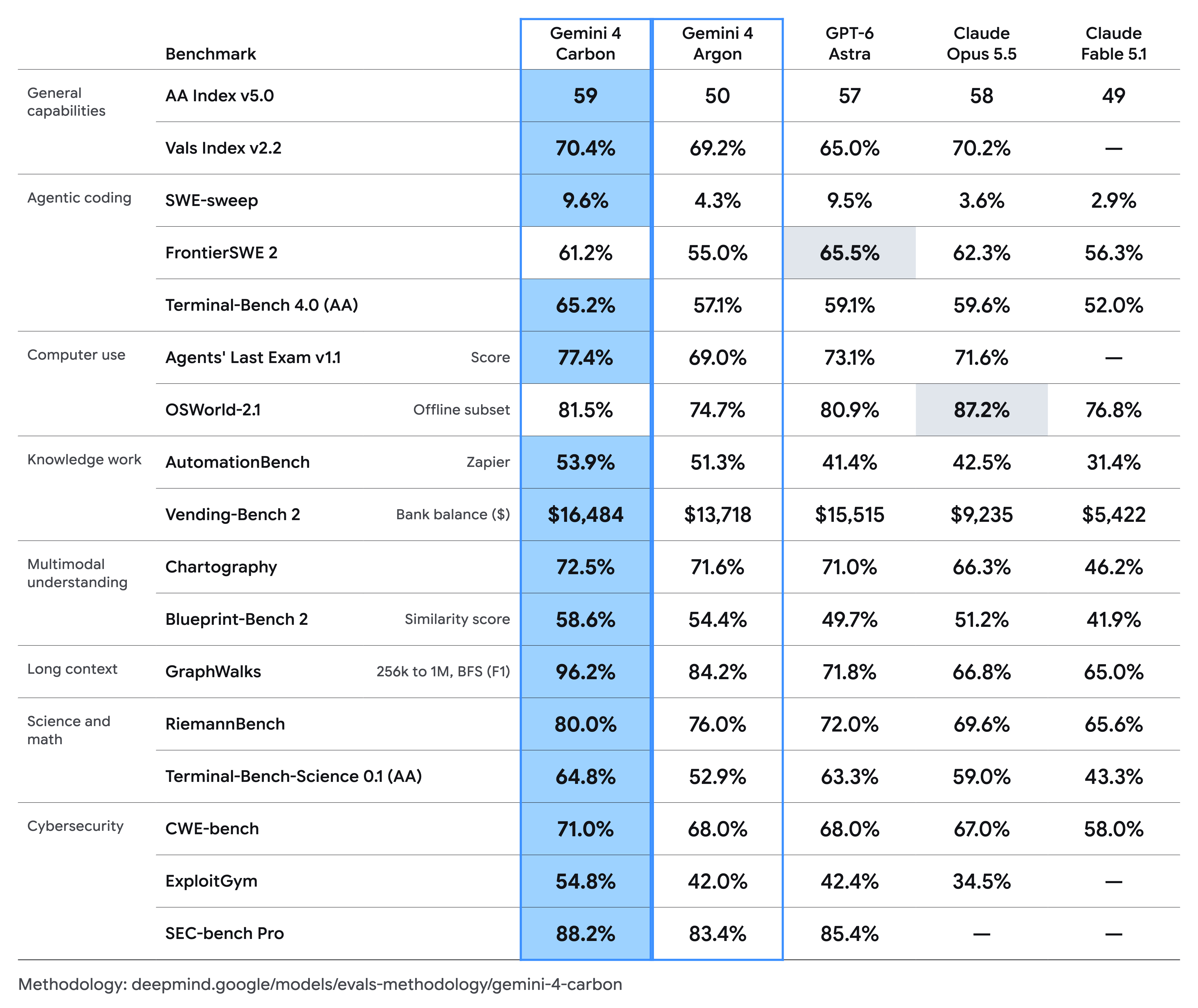
These results come from Google's October 28 Carbon launch comparison, not APIMaster tests. Both values in each row come from the same published table. Percentage differences below are percentage points, not relative percentage gains.
| Evaluation | Carbon | Argon | Change |
|---|---|---|---|
| AA Intelligence Index v5 | 59 | 50 | +9 index points |
| Vals Index v2.2 | 70.4% | 69.2% | +1.2 percentage points |
| SWE-sweep | 9.6% | 4.3% | +5.3 percentage points |
| Terminal-Bench 4.0 | 65.2% | 57.1% | +8.1 percentage points |
| Agents' Last Exam | 77.4% | 69.0% | +8.4 percentage points |
| GraphWalks, 256K–1M BFS F1 | 96.2% | 84.2% | +12.0 percentage points |
| RiemannBench | 80.0% | 76.0% | +4.0 percentage points |
| SEC-bench Pro | 88.2% | 83.4% | +4.8 percentage points |
| ExploitGym | 54.8% | 42.0% | +12.8 percentage points |
| CWE-bench | 71.0% | 68.0% | +3.0 percentage points |
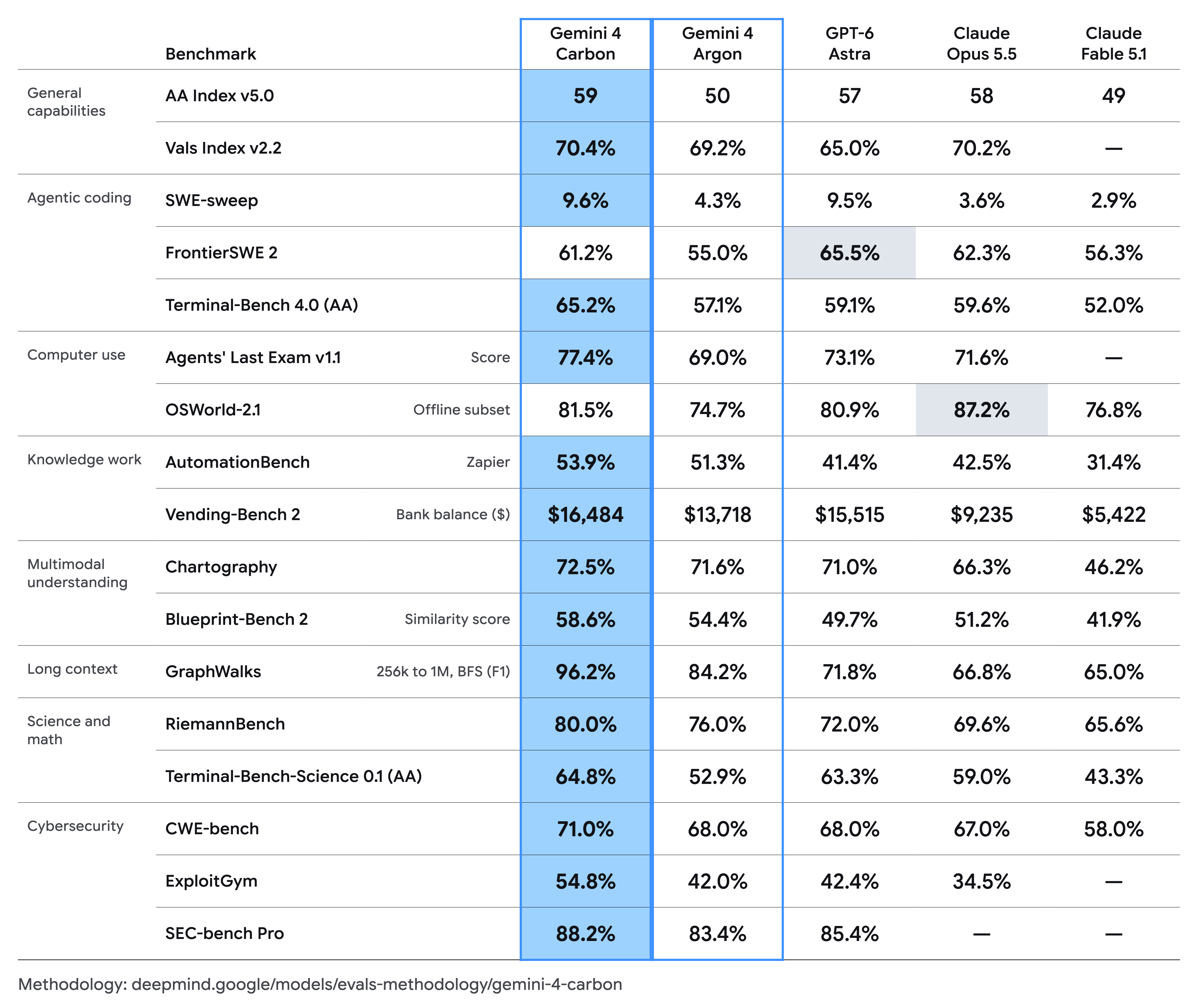
The improvement is broad but uneven: Vals Index gains modestly, while GraphWalks and terminal work gain more. SWE-sweep more than doubles relative to Argon, but Carbon's absolute 9.6% still leaves difficult cases unsolved. Google's external cyber evaluations were run without guardrails; deployed permissions and tools can change behavior.
The Carbon overview discusses independent evaluations and reliability findings. A launch leaderboard is evidence for selecting a candidate, not a promise about every repository or business workflow.
Carbon vs Argon API pricing and fixed-token cost
Google Standard prices are identical for the two models: $2 input / $10 output through 2026-11-30, then $4 / $20 from 2026-12-01. Implicit cached input is $0.10, then $0.20. Output includes thinking. Compare current rates with current rates; the later $4 / $20 reference is not today's Standard bill.
At the 2026-11-11 check, compare the Carbon card and Argon card:
| Same fixed token budget | Google Standard, either model | APIMaster Carbon from | APIMaster Argon from |
|---|---|---|---|
| 100,000 input + 20,000 billed output | $0.40 | ~$0.07177 | ~$0.16683 |
| 1,000 tasks at that budget | $400 | ~$71.77 | ~$166.83 |
These are arithmetic examples, before tools, cache, media, retries and other fees. They assume identical billable tokens. Carbon's lowest quote saves about $95.06 per 1,000 tasks relative to Argon's at that exact budget. A model using fewer reasoning tokens or needing fewer attempts can reverse the actual task-cost ordering.
Which model fits coding, reasoning and high-volume work?
| Workload | First candidate | What decides the result |
|---|---|---|
| Complex repository repair | Carbon | Accepted patch, passing tests, regression rate and repair turns |
| Long-document reasoning | Carbon | Recall, constraints, citations and unsupported claims |
| Defensive security patching | Carbon | Validated fix plus legitimate behavior after patching |
| Existing stable Argon workflow | Keep Argon as baseline | Carbon's measured quality and total bill on the same fixtures |
| Latency-sensitive or high-volume requests | Compare Argon, Carbon and Flash | p95 latency, throughput and cost per accepted output |
Use the same prompt, tools, files, output requirements and acceptance criteria. Record failed calls, human interventions, elapsed time and total billed tokens. These are suggested evaluation tasks, not measured wins. For routine formatting or extraction, a cheaper Flash tier may already meet the requirement.
How to switch between Carbon and Argon
Register with APIMaster → create an API key → use API Base https://apimaster.ai/v1 and model ID gemini-4-carbon. Compare the Carbon card and Argon card before choosing a route.
import os
from openai import OpenAI

client = OpenAI(
    api_key=os.environ["APIMASTER_API_KEY"],
    base_url="https://apimaster.ai/v1",
)
response = client.chat.completions.create(
    model="gemini-4-carbon",
    messages=[{"role": "user", "content": "Review this migration plan and propose verification steps."}],
)
print(response.choices[0].message.content)
print(response.usage)
To compare Argon, change only the model field to gemini-4-argon, keeping the saved task and supported options constant. The example has not been executed as a paid benchmark here. Confirm structured output, grounding, tool calling and long decode on each selected route before comparing advanced workflows.
FAQ
Is Carbon better than Argon?
Carbon leads across Google's selected October 28 launch benchmarks. That supports trying it for difficult work, but your own completion rate, latency and total task bill decide the deployment choice.
Is Carbon more expensive?
Current Google Standard prices are identical. On APIMaster, Carbon's lowest checked token quote is about 57.0% below Argon's, but total task costs can differ with token consumption and retries.
Are both models released?
Yes. Argon API GA is October 13 and Carbon API GA is November 10, 2026. Both now have public active APIMaster routes.
Do both have a 1M context?
Both document 1,048,576 tokens shared across input, thinking and output. Default synchronous output is 65,536; long decode is a separate flow and compatible-route support must be checked.
Is Argon faster on APIMaster?
Google positions Argon for efficient work with faster responses and fewer tokens per turn. This article has no controlled APIMaster latency measurement, so test your selected routes and task mix.
Where can I compare current prices?
Open the Carbon card and Argon card. The live marketplace cards are authoritative; prices and capacity can change.
Sources
- Google Gemini API changelog: Carbon GA on November 10
- Google Carbon model specification
- Google Argon model specification
- Google current API pricing
- Google Carbon announcement and launch evaluations, October 28
- APIMaster live Carbon data · Argon data
- Original Google launch evaluation table
- Google model directory: positioning