
GPT-5.6 Sol, Terra & Luna Now on APIMaster — 90% Off Launch Offer
GPT-5.6 Sol, Terra, and Luna are now live on APIMaster.ai at 90% off. Compare their coding, agentic, knowledge-work, speed, and cost advantages and start using the OpenAI-compatible API.
Published 2026-06-27
On July 9, 2026, OpenAI (~500M monthly visits, SimilarWeb estimate) made the GPT-5.6 family generally available: Sol (flagship), Terra (balanced), and Luna (fastest and most affordable). All three models are now live on APIMaster.ai with a limited-time 90% OFF launch offer, through an OpenAI-compatible API. Official list prices are $5 / $30, $2.50 / $15, and $1 / $6 per 1M input/output tokens respectively.
APIMaster price check, 2026-09-24: The table puts the reference price, current APIMaster price, active routes, and model card side by side. Prices can change; use the market card as the source of truth。
| Model ID | Reference price (per 1M input / output) | Current APIMaster price | Active routes | Discount | Model card |
|---|---|---|---|---|---|
gpt-5.6-sol |
$5 / $30 |
$0.2458 / $1.4746 |
22 | 95% off | View discount |
gpt-5.6-terra |
$2 / $12 |
$0.0596 / $0.3575 |
19 | 97% off | View discount |
gpt-5.6-luna |
$0.20 / $1.20 |
$0.0178 / $0.1067 |
7 | 91% off | View discount |
Buy GPT-5.6 on APIMaster → Choose Luna for volume, Terra for everyday production, or Sol for the hardest agentic work. The 90% OFF promotion is time-limited.
GPT Trial(GPT-6 Astra, GPT-6 Sol, GPT-5.6, and GPT-5.5 available)
Sign up and claim a $20 GPT trial
What OpenAI Announced
OpenAI is introducing a new naming scheme with GPT-5.6:
- The number (5.6) marks the generation.
- Sol, Terra, and Luna are durable capability tiers that can evolve on their own release cadence.
During the preview, all three models are aimed at different cost/latency points on the same generation:
| Tier | Positioning | Input (per 1M tokens) | Cached input | Output (per 1M tokens) |
|---|---|---|---|---|
| Sol | Flagship for ambitious agentic work | $5.00 | $0.50 | $30.00 |
| Terra | Balanced model for everyday work | $2.50 | $0.25 | $15.00 |
| Luna | Fast, affordable high-volume work | $1.00 | $0.10 | $6.00 |
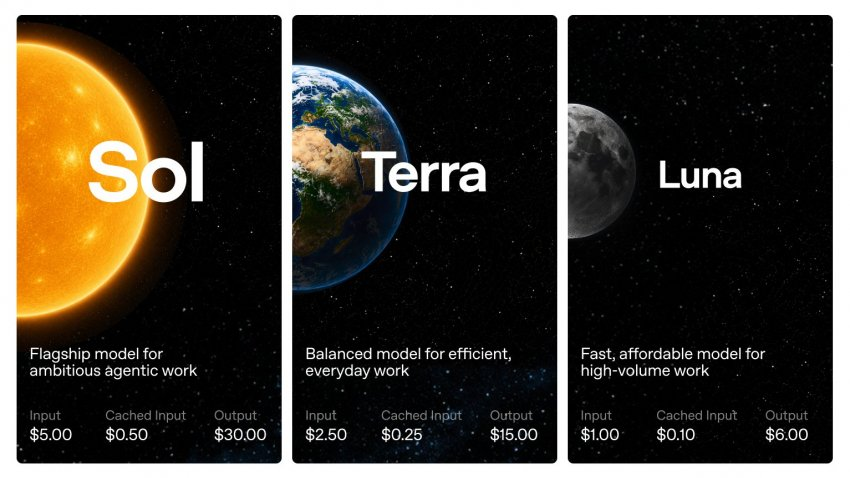
OpenAI states that Terra matches GPT-5.5-level performance at roughly half the cost, while Luna delivers strong capability at the lowest price point in the family.
Sol: Flagship Capabilities Developers Care About
GPT-5.6 Sol is positioned as OpenAI’s strongest model yet for long-horizon, tool-using workflows.
Highlights from the announcement:
- Terminal-Bench 2.1 — new state of the art on command-line agent tasks (planning, iteration, multi-tool coordination).
- GeneBench v1 — improved biology/genomics analysis vs GPT-5.5 with fewer tokens.
- Cybersecurity — competitive on ExploitBench² and ExploitGym³ with strong efficiency; OpenAI emphasizes defensive use cases (patching, review, education) over offensive automation.
maxreasoning effort — gives Sol more time to reason deeply on hard problems.ultramode — coordinates subagents for complex work beyond a single agent loop.
For production coding stacks (Codex, Cursor, custom agents), Sol is the tier to watch when your bottleneck is quality and multi-step reliability, not raw tokens per second.
Terra and Luna: When to Pick Which Tier
Use this decision frame:
| If your workload is… | Start with… | Why |
|---|---|---|
| Multi-file refactors, long agent runs, security research, deep reasoning | Sol | Highest capability ceiling; new max / ultra modes |
| Daily chat, RAG, moderate coding, most SaaS features | Terra | ~GPT-5.5 class at 2× lower official price vs Sol |
| Classification, extraction, high-QPS chat, bulk summarization | Luna | Lowest $/token; best for volume |
Rule of thumb: Luna for throughput, Terra for default production, Sol for hard agentic tasks where failure cost exceeds token cost.
Pricing Details That Change Your Bill
Beyond the headline $/1M rates, GPT-5.6 introduces more predictable prompt caching:
- Explicit cache breakpoints in the API.
- Minimum cache lifetime: 30 minutes on GPT-5.6 and later models.
- Cache writes billed at 1.25× uncached input rate.
- Cache reads keep the familiar 90% discount on cached input.
For agent loops that reuse system prompts, tool schemas, or long context prefixes, Terra and Luna can look much cheaper in practice than headline input pricing — but only if your integration actually hits the cache.
Example: on Sol, uncached input is $5/M; cached input is $0.50/M — a 10× reduction on repeated prefix tokens.
Availability: GPT-5.6 Is Live Now
GPT-5.6 is generally available across ChatGPT, Codex, and the OpenAI API. APIMaster has also launched all three API routes: gpt-5.6-sol, gpt-5.6-terra, and gpt-5.6-luna.
GPT-5.6 Sol remains a prior Sol tier, while GPT-6 Sol is now released as gpt-6-sol for complex coding and agent workflows below Astra. See the GPT-6 Sol API and pricing guide for its published specifications, pricing, and practical routing guidance.
For developers, that means no application rewrite: create an APIMaster key, keep the OpenAI SDK, change the base URL, and select the model. You can also switch between tiers without changing your message format.
Safety Stack: Why You May See Refusals or Delays
GPT-5.6 ships with OpenAI’s most layered safety stack to date, especially around cyber and biology dual-use requests.
Expect during preview:
- Hard refusals on prohibited cyber assistance, including jailbreak attempts.
- Paused generations when classifiers flag high-risk output for secondary review.
- Account-level review when patterns look like persistent misuse vs legitimate security work.
- Occasional false positives on legitimate code review, CTF prep, or defensive testing.
OpenAI reports 700k+ A100-equivalent GPU hours of automated red-teaming plus ongoing human expert testing. For enterprise buyers, they mention future privacy-preserving detection and customer-operated safety controls.
If you operate an AI gateway or resell model access, factor higher tail latency and non-deterministic blocks into SLAs during the preview window.
GPT-5.6 vs GPT-5.5: What Actually Changed
| Dimension | GPT-5.5 (prior gen) | GPT-5.6 family |
|---|---|---|
| Tier naming | Single generation label | Sol / Terra / Luna tiers within 5.6 |
| Cost structure | Prior list pricing | Terra ~half Sol; Luna lowest |
| Agent modes | Standard reasoning efforts | Sol adds max + ultra subagents |
| Caching | Prior behavior | 30-min min cache, explicit breakpoints, 1.25× write premium |
| Cyber evals | Strong | Sol/Terra/Luna all improve; Sol most capable |
| Release | GA paths | Phased preview with stronger safeguards |
GPT-5.6 Is 90% Off on APIMaster.ai
All three GPT-5.6 models are available now on APIMaster.ai with a limited-time 90% OFF offer. Access is pay-as-you-go from $1, requires no subscription, and works with the OpenAI SDK.
Step-by-step
- Register — free account, email or OAuth.
- Top up from $1 — wallet in the console; supports PayPal, card, and other methods listed at checkout (often easier than binding a card directly on platform.openai.com).
- Open the marketplace — search for GPT-5.6, Sol, Terra, or Luna, then choose a 90%-off route and review its live price.
- Create an API key in the console → copy once.
- Point your SDK at APIMaster’s base URL and the model slug shown on the marketplace card:
from openai import OpenAI

client = OpenAI(
    api_key="YOUR_APIMASTER_KEY",
    base_url="https://apimaster.ai/v1",
)

resp = client.chat.completions.create(
    model="gpt-5.6-terra",  # or gpt-5.6-sol / gpt-5.6-luna
    messages=[{"role": "user", "content": "Reply with exactly: ok"}],
    max_tokens=16,
)
print(resp.choices[0].message.content)
- Verify before you scale — run the same key through the free model fingerprint tester. During preview scarcity, some relays silently downgrade model tier; APIMaster’s detection helps you confirm you’re getting what you paid for.
Tier picking on APIMaster: use Luna routes for bulk/low-risk calls, Terra as your default production model, and Sol when agent quality matters more than $/token.
Get GPT-5.6 at 90% off → The promotional price may change, so check the live marketplace rate before sending production traffic.
Start Building with GPT-5.6 Today
Sol, Terra, and Luna are already on APIMaster. Follow these channels for price changes, route updates, and model verification results:
- Telegram group — model launch alerts, pricing changes, and support (t.me/apimasterai, ~community channel)
- Contact / community page — Telegram QR and feedback form
- Blog — deep dives like this one when major models ship
- Changelog — product and routing updates
APIMaster publishes model availability and verification updates so you can switch base_url without rewriting your app.
Create your account → · Browse marketplace → · Join Telegram →
FAQ
What are GPT-5.6 Sol, Terra, and Luna? They are three capability tiers in OpenAI’s GPT-5.6 generation: Sol is the flagship agentic model, Terra is a balanced everyday tier (~GPT-5.5 class at lower cost), and Luna is the fast, lowest-cost tier for high-volume work.
How much does GPT-5.6 cost on the official API? List pricing per 1M tokens is Sol $5 input / $30 output, Terra $2.50 / $15, Luna $1 / $6, with cached input at 10% of uncached input price (90% discount). Cache writes cost 1.25× uncached input; cache entries last at least 30 minutes.
Is GPT-5.6 available on APIMaster today? Yes. GPT-5.6 Sol, Terra, and Luna are all live on APIMaster.ai and currently participate in the 90% OFF launch promotion.
What is GPT-5.6 Sol ultra mode?
ultra goes beyond a single agent by orchestrating subagents to accelerate complex tasks. It targets workloads where parallel exploration beats one long serial chain.
How does GPT-5.6 compare to GPT-5.5 for developers? Terra is positioned as competitive with GPT-5.5 at about half the official cost. Sol exceeds GPT-5.5 on agentic, biology, and cyber benchmarks OpenAI published. Luna trades peak capability for lowest $/token.
How do I choose between Sol, Terra, and Luna? Choose Sol for the highest capability and demanding agents, Terra as the balanced production default, and Luna for low-latency, high-volume workloads.
Where can I read the primary source? OpenAI’s announcement: GPT-5.6: Frontier intelligence that scales with your ambition (July 9, 2026).