Gemini 4 Argon: Google's Long-Horizon Frontier Model Explained
Google announced Gemini 4 Argon on September 30, 2026 for complex software engineering, enterprise knowledge work and cyber defense. Track its reported pricing, benchmarks, limited Fairwind access, and the Gemini API routes developers can use today.
Published 2026-09-30 · Updated 2026-10-01
Gemini 4 Argon is Google's first announced Gemini 4 frontier model, but it is not a general-public API yet. Google announced Argon on September 30, 2026, positioning it for long-running software engineering, enterprise knowledge work and cyber defense. The first access described by Google is through the Fairwind program for trusted cyber defenders; a broad paid API or Google AI Ultra launch date has not been announced.
The headline capability is a reported up to 1 million output tokens in one response, compared with the much smaller output limits developers are used to on most current frontier APIs. Google says its internal teams are already using Argon for large refactors, C/C++ to Rust migrations, memory optimization and other long-horizon tasks. The benchmark table published with the announcement reports 77.9% on DeepSWE v1.1, 68.9% on Vals Index knowledge work, 19.6% on Harvey's Legal Agent Benchmark, and strong results on several other enterprise and coding evaluations. These are vendor-published results, not an independent APIMaster test.
The reported introductory price is $2 / 1M input tokens and $10 / 1M output tokens, with cached input reported at about $0.10 / 1M tokens. Google is expected to move to $4 / $20 after the introductory period, but the public API catalog and a generally available Argon route should be treated as the source of truth when they appear. Argon currently has no confirmed APIMaster route.
For a Gemini API you can actually call today, APIMaster has active routes for Gemini 3.8 Flash, Gemini 3.7 Flash and Gemini 3.6 Flash. As checked on October 1, 2026, the lowest active Gemini 3.8 Flash route was $0.2999 input / $1.4993 output per 1M tokens, with seven active routes. Check the live card before sending traffic because route capacity and prices can change.
| Model ID | Official list price (per 1M input / output) | APIMaster current price | Active routes | Discount | Model card |
|---|---|---|---|---|---|
gemini-4-argon |
Reported intro $2 / $10; later $4 / $20 | No public route confirmed | 0 | — | View model card |
gemini-3.8-flash |
$1.50 / $7.50 | $0.2999 / $1.4993 | 7 | about 80% | View discount |
gemini-3.7-flash |
$1.50 / $7.50 | $0.2999 / $1.4993 | 7 | about 80% | View discount |
gemini-3.6-flash |
$1.50 / $7.50 | $0.36 / $1.80 | 4 | about 76% | View discount |
gpt-6-astra |
$10 / $50 | $0.4465 / $2.2327 | 14 | about 96% | View discount |
claude-fable-5-1 |
$10 / $50 | $2.3755 / $11.8774 | 7 | about 76% | View discount |
claude-opus-5-5 |
$4 / $20 | $1.3359 / $6.6794 | 9 | about 67% | View discount |
Price snapshot checked October 1, 2026. APIMaster prices are the lowest active route returned by the public marketplace endpoint at that time; the live marketplace card is authoritative. Argon pricing and availability are reported launch information, not a confirmed APIMaster listing.
GPT Trial(GPT-6 Astra, GPT-6 Sol, GPT-5.6, and GPT-5.5 available)
Sign up and claim a $20 GPT trial
What is Gemini 4 Argon?
Gemini 4 Argon is the first announced member of Google's Gemini 4 generation. Unlike a consumer-first launch focused on chat features, Google presented Argon as a model for work that takes many steps, uses large amounts of context and may run for a long time before producing a useful result. For the broader Gemini 4 training and availability timeline, see the Gemini 4 overview.
The three launch areas are:
- Software engineering: repository-scale changes, debugging, migrations and coding-agent loops.
- Enterprise knowledge work: legal, financial and operational research where the model must track many constraints and sources.
- Cyber defense: defensive security analysis released first to trusted participants in Google's Fairwind program.
This positioning matters for API buyers. A high benchmark score is not the same as public availability, predictable latency or a stable billing contract. Until Argon is listed in Google's API documentation with a model ID and limits, developers should treat the announcement as a capability and access update—not as an endpoint they can call.
What can Argon do?
One-million-token output ceiling
Google's announcement highlights a maximum of 1 million output tokens in a single response. If the limit is delivered as described, it could change how developers design large refactors, long reports and multi-stage agent workflows: the model may be able to keep more of a task's intermediate result in one response instead of forcing the application to split the job into many continuation calls.
That number should not be confused with guaranteed useful output, context capacity, rate limits or affordable production usage. A million-token response is also a million-token bill at the output rate. Teams should measure completion quality, cancellation behavior, latency and total cost on representative tasks before treating the limit as a reason to remove application-side checkpoints.
Long-horizon engineering and knowledge work
Google describes internal Argon projects that include data-center memory optimization, C/C++ migrations to Rust and video-decoder acceleration. These examples are useful signals about the intended workload, but they are internal case studies rather than reproducible public evaluations. The correct production test is to run a fixed repository or document set against Argon and current alternatives with the same tools, budget and grading rubric.
Cyber defense first
The initial Fairwind access is a meaningful part of the product story. It means the first users are trusted cyber defenders rather than the general developer population. That can let Google learn from high-risk defensive workflows while keeping access, abuse controls and feedback loops constrained.
It also means that “announced” does not mean “available in AI Studio, Gemini API or APIMaster.” Developers should not copy a guessed identifier such as gemini-4-argon into production and infer success from a third-party route label.
Benchmark results: what Google published
The announcement comparison screenshot lists Argon beside GPT-6 Astra, Claude Fable 5.1 and Claude Opus 5.5. Representative values shown in the published table include:
| Evaluation | Gemini 4 Argon | GPT-6 Astra | Claude Fable 5.1 | Claude Opus 5.5 |
|---|---|---|---|---|
| Vals Index knowledge work | 68.9% | 63.1% | 65.8% | 67.0% |
| AutomationBench | 51.3% | 41.4% | 31.4% | 42.5% |
| Vals Finance Agent v2 | 65.4% | 53.5% | 58.9% | 58.6% |
| Harvey's Legal Agent Benchmark | 19.6% | 5.4% | 6.7% | 3.8% |
| DeepSWE v1.1 | 77.9% | 74.1% | 67.4% | 74.2% |
| FrontierSWE v2 | 55.0% | 65.5% | 56.3% | 62.3% |
| Vibe Code Bench | 91.9% | 89.6% | 90.3% | 90.3% |
| Terminal-bench 4.0 | 57.4% | 58.2% | 57.9% | 66.4% |
| CWE-bench v1 | 68.0% | 68.0% | 58.0% | 67.0% |
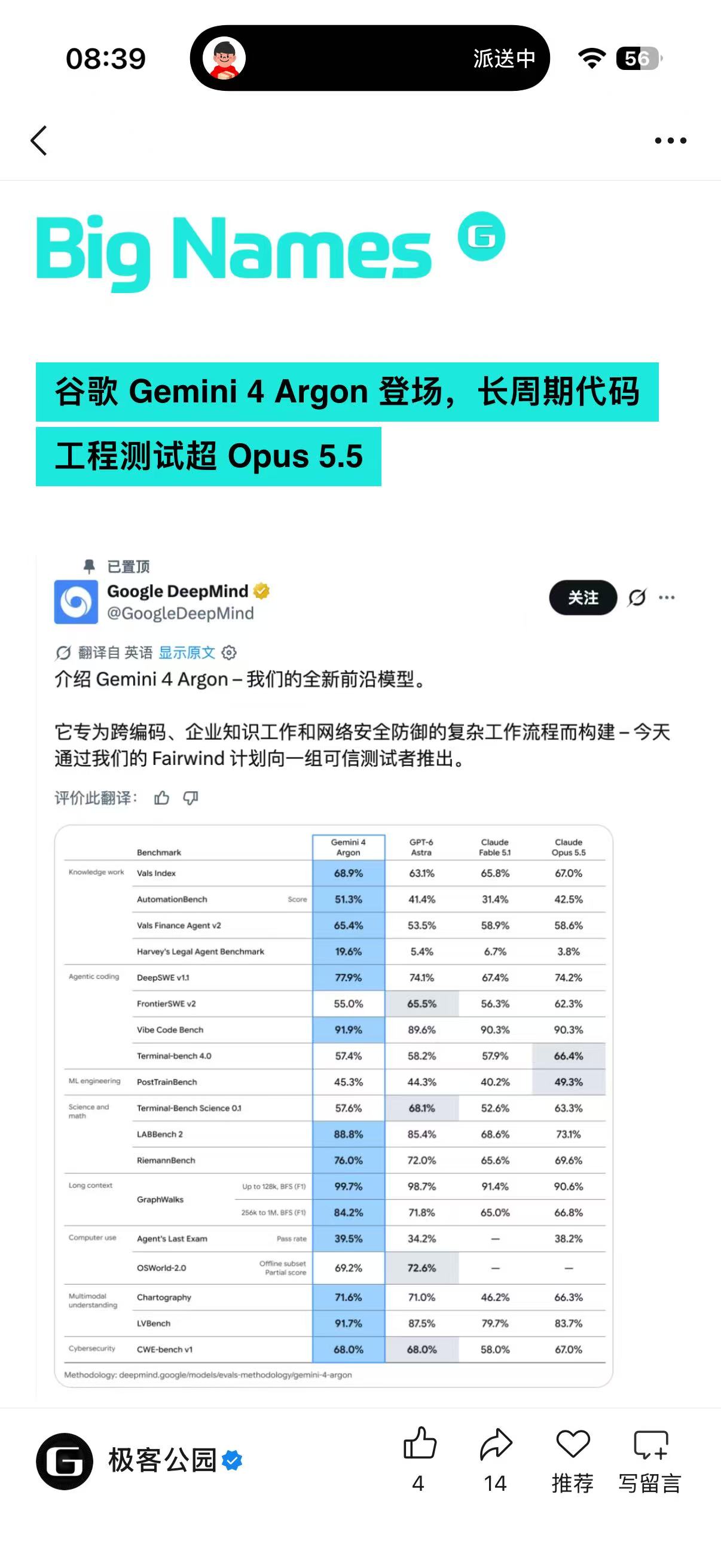
Editorial image: screenshot supplied by the user. The visible post is attributed to GEEKPark and includes an image of a purported Google DeepMind announcement; this is not an original, independently authenticated capture of Google's X post. Verify the original post and methodology before treating the scores as independently validated.
The table is not uniformly favorable to Argon. The screenshot shows GPT-6 Astra ahead on FrontierSWE v2 and OSWorld-2.0, while Claude Opus 5.5 leads Terminal-bench 4.0 and PostTrainBench. That is why a headline such as “Argon wins every benchmark” would be misleading. Google's results support a more specific conclusion: Argon is competitive or ahead on many long-horizon, enterprise and defensive-work evaluations, while other models remain stronger on selected computer-use, coding and post-training tasks.
Independent commentary is already split. Artificial Analysis describes Argon as tied with GPT-6 Astra on its Intelligence Index and highlights lower hallucination rates and improved agent behavior. Other researchers question how much of that score comes from refusal behavior, benchmark weighting and a methodology that is still changing. Treat those claims as external analysis, not as a replacement for the primary benchmark definitions.
Who announced Argon on X?
The launch conversation is concentrated around a small group of official and analysis accounts:
- Google DeepMind announced Argon and the Fairwind-first access model.
- Google emphasized the one-million-token output ceiling and frontier results.
- Sundar Pichai explained why Google was sharing the announcement early and stressed internal use, safety guardrails and staged access.
- Logan Kilpatrick discussed the reported introductory $2 / $10 price and the plan to expand access.
- Artificial Analysis published an independent comparison and Intelligence Index commentary.
The recurring developer response is straightforward: the benchmarks look attractive, but most developers cannot call Argon yet. The practical questions are when the paid API opens, whether Google AI Ultra receives access, how stable million-token jobs are, and whether the introductory price survives general availability.
What Gemini models can developers use today?
Gemini 3.8 Flash
Gemini 3.8 Flash is the strongest currently visible Gemini route in the APIMaster marketplace. It is a practical choice for high-volume text work, coding assistants, structured extraction and multimodal workflows where a released Flash-tier model is more important than Argon's frontier positioning.
Open the live Gemini 3.8 Flash card for current providers, health signals and route pricing. The current marketplace snapshot found seven active routes, with the lowest route at about $0.2999 / $1.4993 per 1M input / output tokens.
Gemini 3.7 Flash and 3.6 Flash
Gemini 3.7 Flash and Gemini 3.6 Flash remain useful fallback choices when a workload needs multiple channels, a specific capacity profile or a model version already tested by the application. The snapshot found seven active 3.7 routes and four active 3.6 routes.
These are not Argon substitutes in capability claims. They are available Gemini options for building the integration, collecting workload baselines and preparing a controlled model switch later.
Other frontier alternatives on APIMaster
If your task is available now rather than waiting for Argon, APIMaster also exposes active routes for GPT-6 Astra, Claude Fable 5.1 and Claude Opus 5.5. The table above uses the same marketplace snapshot for all three, so the comparison separates official reference price from the lowest active APIMaster route.
The right choice depends on the workload:
| Workload | Start with | Why |
|---|---|---|
| Large coding-agent loops | Gemini 3.8 Flash or GPT-6 Astra | Compare repository completion, repair turns and tool-call reliability. |
| Legal and enterprise analysis | Claude Opus 5.5 or Fable 5.1 | Measure citation quality, constraint tracking and refusal behavior. |
| High-volume Gemini integration | Gemini 3.7 Flash or 3.8 Flash | Keep the provider and API shape stable while Argon access is limited. |
| Security-defense research | A currently released model with approved tools | Do not send sensitive data to an unverified Argon route. |
How to prepare for the Argon API
Do not build production code around an unconfirmed endpoint. Instead:
- Keep prompts, tools, input fixtures and grading criteria versioned.
- Establish a baseline with a released Gemini route and at least one non-Gemini alternative.
- Record accepted output quality, tool-call success, latency, retries, token usage and cost.
- When Google publishes Argon API documentation, test the exact model ID in a separate environment.
- Promote it only after the model card, limits, safety policy and billing behavior are verified.
A minimal OpenAI-compatible request through APIMaster looks like this once you choose a released model:
curl "$API_BASE/v1/chat/completions" \
  -H "Authorization: Bearer $APIMASTER_API_KEY" \
  -H "Content-Type: application/json" \
  -d '{
    "model": "gemini-3.8-flash",
    "messages": [{"role": "user", "content": "Summarize this repository plan."}]
  }'
Create an APIMaster account, add a key in the console, use the API base, and select a model that appears in the live marketplace. Do not replace gemini-3.8-flash with gemini-4-argon until Google and the route catalog confirm that identifier.
Bottom line
Gemini 4 Argon is an important announcement because it targets the part of the frontier where model quality is measured by completing long, messy workflows rather than answering one prompt. Google's published table presents strong results on knowledge work, legal-agent, software-engineering and cybersecurity evaluations, and the reported one-million-token output ceiling is unusually ambitious.
But the launch is deliberately staged. As of October 1, 2026, Argon is not a generally available Gemini API or a confirmed APIMaster route. The useful action today is to benchmark your real workload on a released Gemini route—especially Gemini 3.8 Flash—or on another active frontier channel, then keep the evaluation harness ready for Argon's eventual public API.
FAQ
Is Gemini 4 Argon available through the Gemini API?
Not generally. Google announced Argon on September 30, 2026 and described initial access through Fairwind for trusted cyber defenders. A broad paid API launch has not been confirmed in the public information covered here.
Can I use Gemini 4 Argon through APIMaster?
There is no confirmed APIMaster Argon route as of October 1, 2026. Use a released model shown in the live marketplace, such as gemini-3.8-flash, and check the model card before integrating.
How much does Gemini 4 Argon cost?
The reported introductory price is $2 per 1M input tokens and $10 per 1M output tokens, with cached input reported near $0.10. A later $4 / $20 price has also been reported. Treat both as launch reporting until Google's public API pricing page publishes the final contract.
What is Argon's context or output limit?
The launch material highlights up to 1 million output tokens in a single response. Developers still need to verify context limits, rate limits, latency, truncation behavior and billing in the eventual API documentation.
Does Argon beat GPT-6 Astra and Claude Opus 5.5 everywhere?
No. Google's comparison shows Argon ahead or competitive on many listed evaluations, but GPT-6 Astra and Claude Opus 5.5 lead selected coding, computer-use and post-training tasks. Benchmark methodology and workload fit matter.
What Gemini model should I use today?
Start with the released Gemini route that matches your workload and appears in the live catalog. The October 1, 2026 snapshot found active APIMaster routes for Gemini 3.8 Flash, Gemini 3.7 Flash and Gemini 3.6 Flash. Check the Gemini 3.8 Flash card for current price and provider availability.
Sources and verification notes
- Google DeepMind on X — primary announcement account referenced by the launch screenshot.
- Google on X — product announcement and access framing.
- Sundar Pichai on X — staged access, internal use and safety context.
- Logan Kilpatrick on X — Gemini API and reported introductory price discussion.
- Artificial Analysis on X — independent benchmark and Intelligence Index commentary.
- Google DeepMind Gemini models — official model-family reference.
- Google AI for Developers model documentation — API model availability should be checked here when Argon opens.
The benchmark figures and Argon access details in this article are attributed to the launch material and clearly separated from the live APIMaster marketplace snapshot. Re-check both before making a production decision.