
Build complete applications in the terminal with an AI agent
Combine models such as Qwen to iteratively write and refine code step by step via the agent
Best for:Independent developers
Coding / Developer
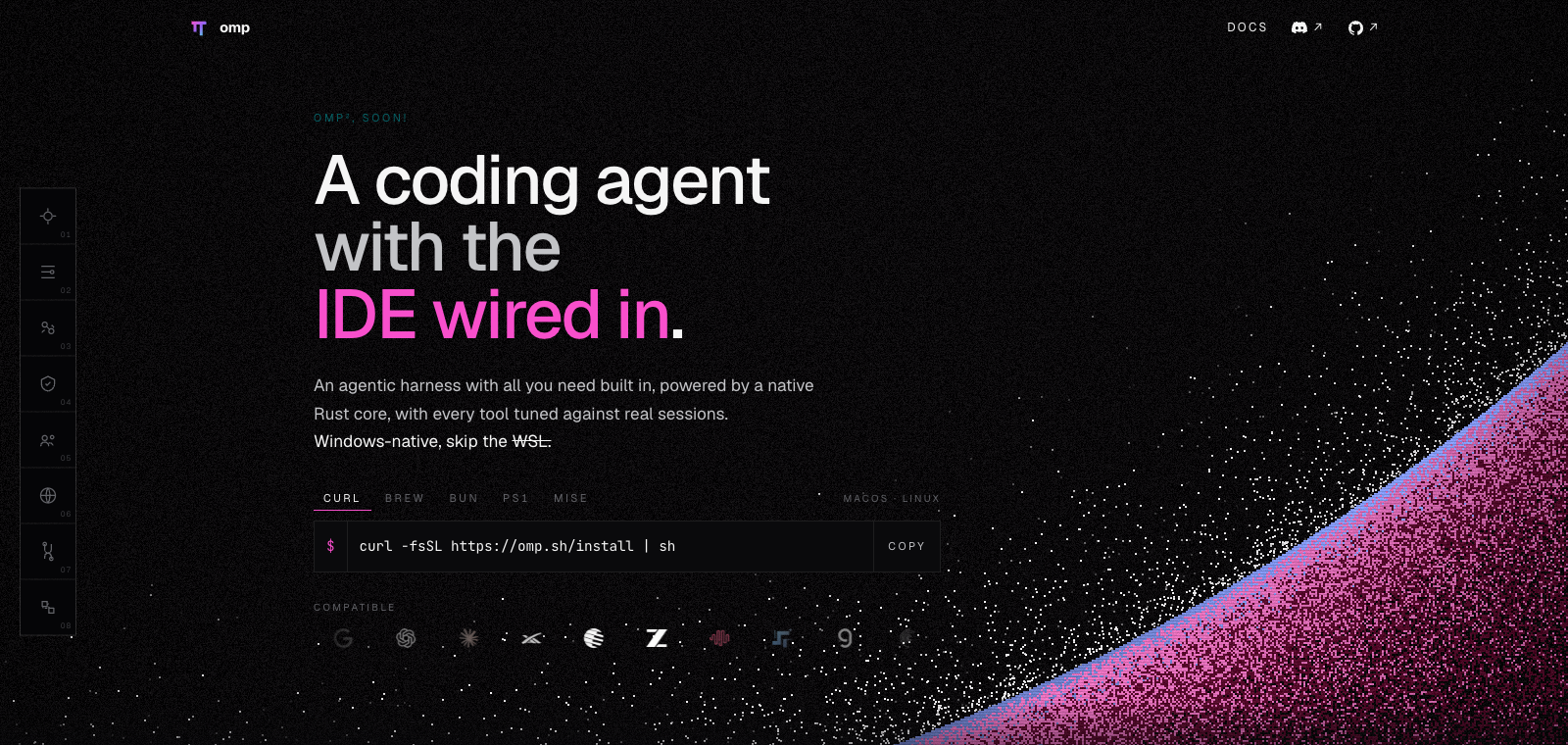
omp is an open-source terminal coding agent that supports over 60 model providers and allows switching models within a session.
Website created
2026-05-11
OpenRouter token usage rank
#7
Sources: OpenRouter
Monthly unique visitors
187,532
Sources: SimilarWeb
Coding Plan
Coding Pro model discounts
omp is positioned as a command-line agent tool for developers to use in local projects, running via TUI or GUI interfaces. After launching in the project directory, users can have the agent perform CLI operations and invoke different models to handle tasks. The core feature is support for mid-session model switching and local configuration, avoiding single-model limitations. It suits developers needing flexible model routing and handling real codebases, emphasizing local persistence and multi-model switching compared to cloud-shared agents or fixed-model tools.
One-line summary
omp is an open-source terminal coding agent that supports over 60 model providers and allows switching models within a session.
What people use it for
After users enter omp in the terminal to launch, the agent uses CLI to complete AWS/GCP operations or code modifications; when encountering model limits, enter /switch to switch to another model and continue the task.
Best for
Developers and technical teams
How it works
Run the CLI in the project directory, configure model providers and endpoints, then approve or inspect the agent's operations in the terminal.
Product type
CLI Coding Agent
Pricing
Unknown
Please check the official repository for the project's current pricing and model invocation rules.
APIMaster integration
Supported
~/.omp/agent/models.yml or model Provider configuration
Data confidence
Low
Last verified: 2026-08-29
Directly provide semantic renaming, reference lookup, and diagnostics within the terminal
In-process debugger supporting breakpoints, variable inspection, and step execution
Content-hash-based code modification mechanism
Retains imports, variables, and open file state across sessions and sub-agents
Built-in browser operation capabilities
Use the same toolset to invoke different models via TUI, -p, RPC, ACP and other interfaces
Combine models such as Qwen to iteratively write and refine code step by step via the agent
Best for:Independent developers
Use the native DAP debugger to set breakpoints and inspect variables
Best for:Python developers
Accumulate variables and file state step by step via the persistent kernel for iterative development
Best for:Data scientists and script developers
Have the agent directly operate the browser to complete web-related tasks
Best for:Full-stack developers
Base URL
https://apimaster.ai/v1API key environment variable
$APIMASTER_API_KEYModel
Your APIMaster model IDDiscussion summary
Users typically understand omp as an IDE-integrated AI coding agent tool, emphasizing persistent state management and model routing features for local development and agent workflows. Discussions focus on comparisons with other agent tools, especially memory persistence, orchestration reliability, and real-world delivery capability. Users also pay attention to model routing applications across different tasks and integration methods with specific providers.
Users discuss how this design retains variables, imports, and files across sessions, enabling step-by-step iteration like a Jupyter notebook rather than re-deriving everything each time.
Users share how routing automatically selects models based on tasks and its impact on coding efficiency and cost.
Users compare omp's durable harness and shared agents, discussing which is better suited for real project delivery and feedback loops.
Users inquire about configuring providers, anti-gravity subscriptions, and other details, as well as omp's stability in production environments.
Users discuss its advantages in personal application development and avoiding cloud restrictions, as well as pairing methods with Claude or other models.
It is a terminal-oriented Coding Agent project; specific capabilities should be verified against the current state of the repository.
Currently unknown. The page will not claim support until confirmed in official documentation or actual testing.
This depends on the enabled tools and permissions; each operation should be checked before execution.
Sources:Official websiteGitHub
Last verified: 2026-08-29 · Report a correction