
Submit and monitor containerized AI training jobs from the IDE
Developers select an environment in the local editor, send jobs, and view logs, with outputs pulled automatically after completion
Best for:ML developers
AI Infrastructure / API
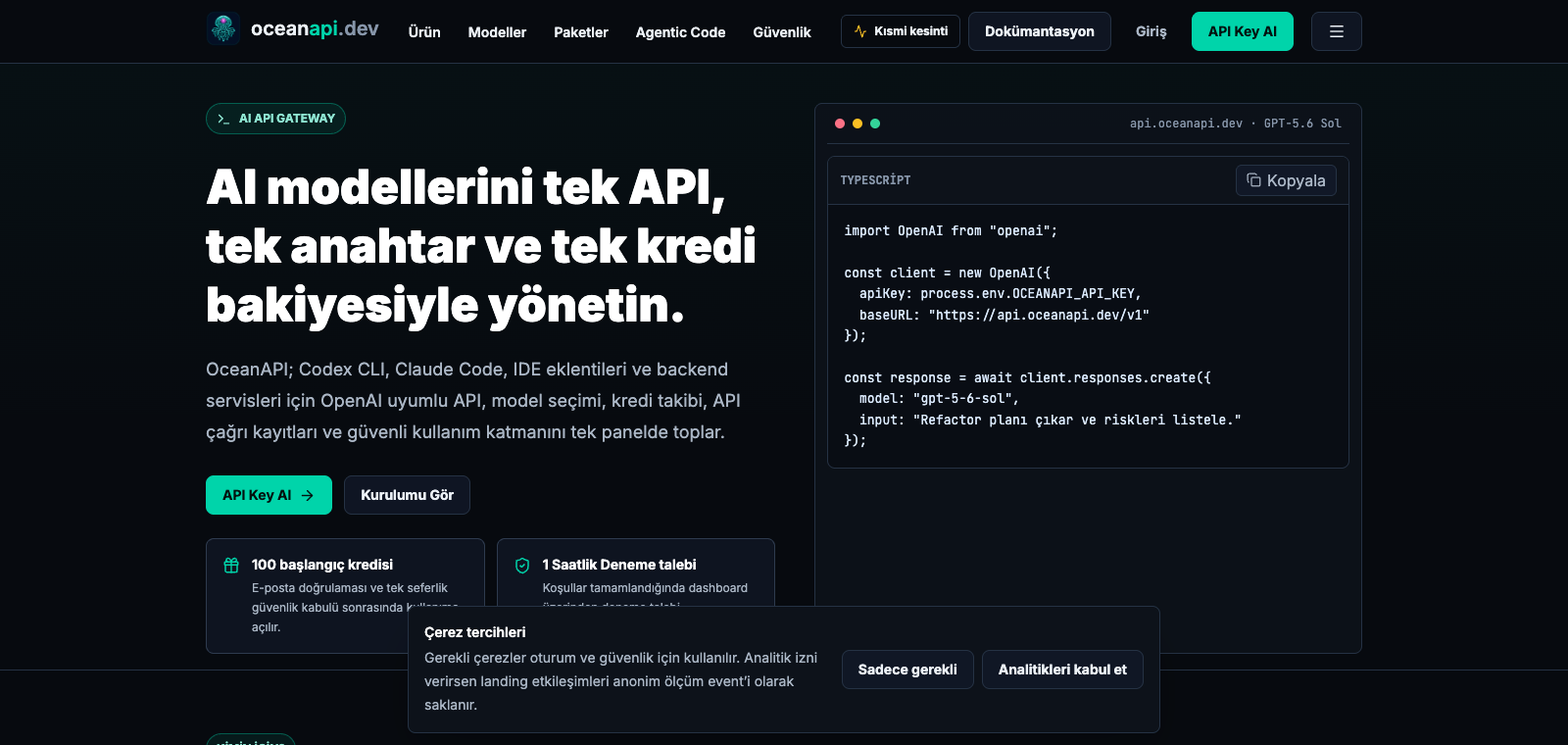
OceanAPI is an API service in the AI Infrastructure space.
Website created
2026-05-15
OpenRouter token usage rank
#49
Sources: OpenRouter
Coding Plan
Coding Pro model discounts
This product is positioned to provide developers with API-based access, with most operations completed through interface calls. Its core characteristic is supporting AI-related tasks as an infrastructure layer. It is suitable for technical users who need to integrate APIs. Compared with similar products, its differences are in specific implementation details that have not been publicly compared in detail.
One-line summary
OceanAPI is an API service in the AI Infrastructure space.
What people use it for
Users actually use it to call API endpoints for AI infrastructure tasks.
Best for
AI application teams, platform engineers, and infrastructure leads
How it works
Users typically start from the command line, IDE, or browser, then complete the work through multi-step task planning and tool calls.
Product type
Model gateway / routing tool
Pricing
Unknown
The current enhanced batch data does not maintain real-time pricing for this product. Please refer to the official website or official documentation.
APIMaster integration
Supported
Provider / Proxy / API settings
Data confidence
Medium
Last verified: 2026-09-02
Pay only for the compute resources actually consumed by containerized jobs, with no need to reserve idle resources
Choose the compute environment, build, and send containerized jobs from within the code editor without switching to a cloud console
Provides machine learning workflow templates that can be used directly to quickly start experiments
Supports the full workflow in which AI agents propose changes, run experiments, evaluate results, and iterate
Run algorithms through Compute-to-Data without data leaving the owner's control
Use Ocean Nodes to access a decentralized compute network for executing ML tasks
Developers select an environment in the local editor, send jobs, and view logs, with outputs pulled automatically after completion
Best for:ML developers
Let AI agents automatically propose model changes, execute experiments, evaluate results, and optimize in a loop
Best for:AI researchers
Execute training tasks through Compute-to-Data without exposing raw data
Best for:Data owners and AI teams
Use the API or Orchestrator to directly call decentralized nodes to complete specific ML tasks
Best for:AI infrastructure users
Base URL
https://apimaster.ai/v1API key environment variable
APIMASTER_API_KEYModel
Your APIMaster model IDDiscussion summary
Users typically understand OceanAPI as a decentralized AI infrastructure and API tool within the Ocean Protocol ecosystem, mainly used to access distributed compute resources, run AI workloads, and maintain data privacy. Discussions focus on how to submit jobs directly through the IDE, pay based on actual runtime, and use Compute-to-Data to enable privacy-preserving ML workflows. Users also frequently discuss the scalability of Ocean Nodes, integration with existing development environments, and how to use its support for autonomous research experiments and iterative optimization.
Users discuss how tools such as Ocean Orchestrator let developers configure environments, submit containerized tasks, and retrieve results directly from the editor without switching cloud platforms.
Users focus on running algorithms without exposing raw data, especially in sensitive scenarios such as healthcare and finance.
Users explore the real-world performance of Ocean Nodes in parallel processing, fault tolerance, and support for Docker/Kubernetes.
Users compare Ocean's pay-per-use model with traditional cloud services, discussing how to reduce idle resource waste and optimize budgets.
Users share workflows where AI agents propose changes, run experiments, evaluate results, and iterate, as well as how this helps ML workflows.
We currently classify it under "AI Infrastructure / API", and the page description is based on the official website and public sources such as OpenRouter.
The enhanced OceanAPI page prioritizes displaying the core tasks and use cases that have been collected, helping you quickly judge whether it matches your current needs.
The current information already confirms that the product supports a third-party Key or custom compatible endpoint, so you can continue verification directly according to the configuration instructions on the page.
Also in the AI Infrastructure / API category, and can be used for side-by-side comparison of different task entry points and product forms.
Also in the AI Infrastructure / API category, and can be used for side-by-side comparison of different task entry points and product forms.
Also in the AI Infrastructure / API category, and can be used for side-by-side comparison of different task entry points and product forms.
Sources:Official website
Last verified: 2026-09-02 · Report a correction