
Evaluate DeepSeek-Coder-6.7B on HumanEval
Run python main.py --model deepseek-ai/deepseek-coder-6.7b-instruct --tasks humaneval
Best for:Model developers
Coding / Developer

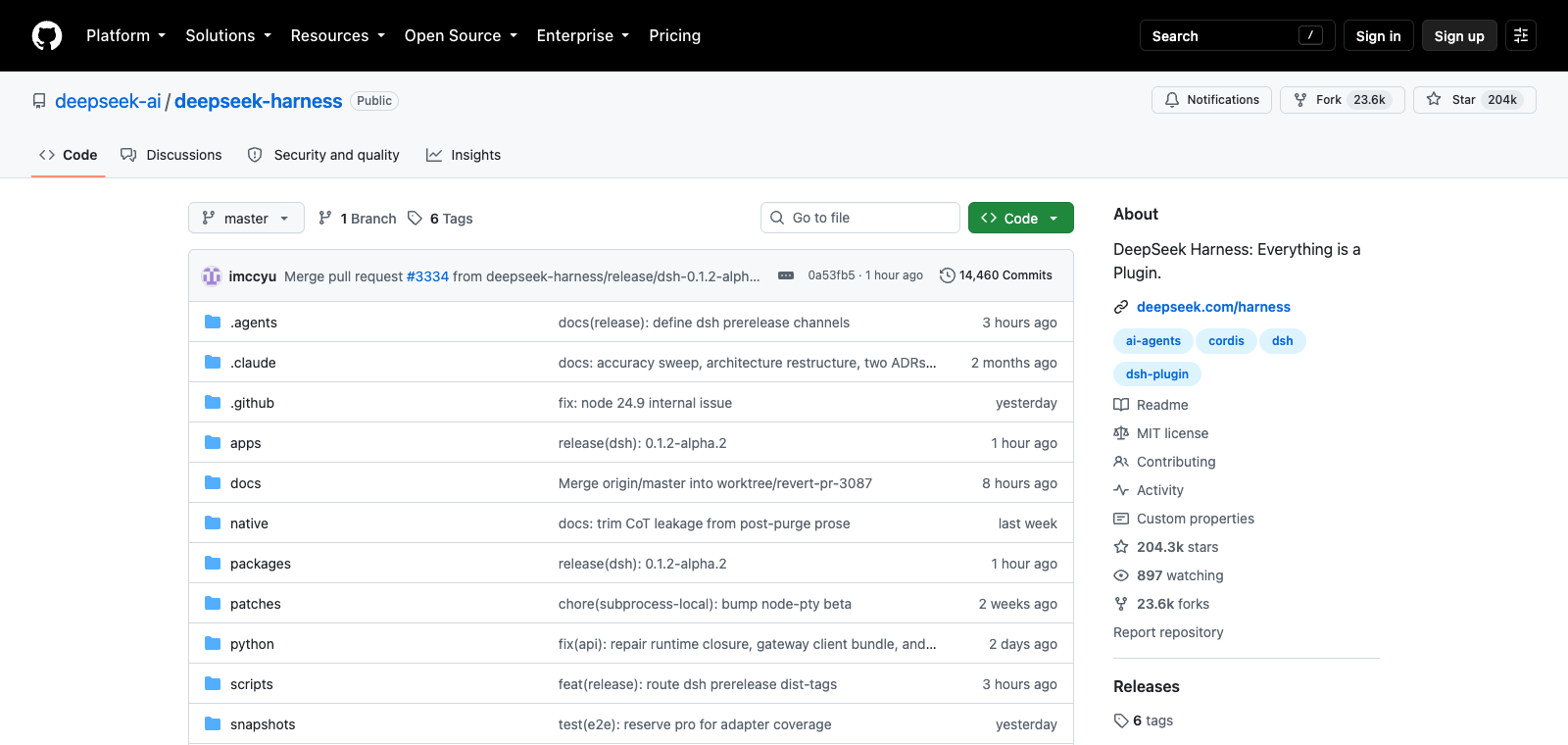
DeepSeek Harness is a GitHub repository maintained by deepseek-ai that provides ready-made evaluation scripts and task configurations for DeepSeek models based on lm-evaluation-harness.
OpenRouter token usage rank
#8
Sources: OpenRouter
Coding Plan
Coding Pro model discounts
This product belongs to the Coding / Developer category and is mainly intended for developers to deploy and use locally or on servers. By cloning the repository, installing dependencies, and running specified commands, users can run standard benchmark tests on DeepSeek series models. Its core strength is that the repository already includes adaptation files and task lists for DeepSeek models, so users do not need to write evaluation code themselves. It is suitable for AI researchers and engineering teams that need consistent evaluation of open-source or proprietary large models. Compared with general evaluation frameworks, it directly ties into DeepSeek model weight loading methods, reducing the model adaptation step.
One-line summary
DeepSeek Harness is a GitHub repository maintained by deepseek-ai that provides ready-made evaluation scripts and task configurations for DeepSeek models based on lm-evaluation-harness.
What people use it for
Users use it to run python scripts, benchmark specific DeepSeek models on datasets such as MMLU and HumanEval, and output scores. Users also use it to compare evaluation results across different model versions or checkpoints in batches.
Best for
Developers, engineering teams, and technical leads
How it works
It typically starts by reading context in an IDE, terminal, or project environment, then the Agent plans steps, executes commands, or modifies files, and the user checks the results.
Product type
Extension / Plugin
Pricing
Unknown
The current enhanced bulk dataset does not maintain real-time pricing for this product. Refer to the official website or official documentation.
APIMaster integration
Supported
DeepSeek Harness → Settings → Models → Add a custom provider
Data confidence
Medium
Last verified: 2026-09-02
Load the HumanEval dataset, run model code generation, and calculate pass@1, pass@10, and pass@100 metrics
Load models through the vLLM engine for batch inference, with support for tensor parallelism and continuous batching
Use YAML files to define task names, dataset paths, prompt templates, and evaluation metrics
Generate JSON files containing detailed results for each sample and overall metrics
Load DeepSeek-Coder series model weights directly from Hugging Face Hub
Built-in MBPP and APPS code generation tasks with support for automatic download and preprocessing
Run python main.py --model deepseek-ai/deepseek-coder-6.7b-instruct --tasks humaneval
Best for:Model developers
Run the same benchmark tests on deepseek-coder-6.7b-base and deepseek-coder-v2-lite-base respectively and compare pass@k
Best for:Researchers
Write a YAML configuration pointing to an internal code repository, then run evaluation to verify model performance on a specific programming language
Best for:Enterprise developers
Configure the vLLM backend to run MBPP and HumanEval on multiple models at the same time and generate comparison reports
Best for:AI engineers
Base URL
https://apimaster.ai/v1API key environment variable
API key(Custom provider 配置项)Model
gpt-5.6-sol or claude-sonnet-4-6 or deepseek-v4-proDiscussion summary
Users usually understand DeepSeek Harness as a highly modular AI coding agent orchestration framework built around the core idea that "everything is a plugin," allowing components such as models, tools, session logs, agent loops, and sub-agents to be freely replaced through configuration or custom plugins. Discussion focuses on how to use its plugin architecture to build personalized workflows, integrate with local models or third-party agents such as Claude Code and Codex, and balance flexibility with stability in real coding tasks. Users also often discuss its architectural differences from similar tools such as Pi and Hermes, with attention on how plugin-based extensions can adapt functionality to different scenarios.
Users discuss how core parts such as model adapters, tool registration, session logs, and agent loops can be seamlessly replaced through plugin-declared dependencies, event listeners, and reversible registration without modifying the framework source code.
Users compare DeepSeek Harness's fully plugin-based Lego-style design with Pi's minimalist foundation or Claude Code's CLI experience, exploring tradeoffs in context management, cost control, and customization freedom, as well as which scenarios fit different workflows.
Users focus on how to connect tools such as Claude Code or Codex as native sub-agents, routing subtasks and checking status and progress through configuration to orchestrate multi-agent collaboration.
Users share installation and configuration experience for connecting local models such as Ollama and Qwen to Harness, adding tool plugins such as web tools and iOS automation, and running and extending it in a local Web UI.
Users discuss using the community plugin directory, writing new plugins to extend memory, sandbox, or UI capabilities, and how plugin API stability affects long-term custom agent development.
We currently classify it under the "Coding / Developer" category, and the page description is based on public sources such as the official website and OpenRouter.
The enhanced page for DeepSeek Harness prioritizes the core tasks and use cases that have already been collected, helping you quickly judge whether it matches your current needs.
Current materials have confirmed that the product supports third-party keys or custom compatible endpoints, so you can continue verification directly according to the page configuration instructions.
Also in the Coding / Developer category, suitable for side-by-side comparison of different task entry points and product formats.
Also in the Coding / Developer category, suitable for side-by-side comparison of different task entry points and product formats.
Also in the Coding / Developer category, suitable for side-by-side comparison of different task entry points and product formats.
Sources:Official websiteOfficial docsGitHub
Last verified: 2026-09-02 · Report a correction