Gemini Omni 1.2 Flash Is Deployed — Release Coming Soon
According to community reports, gemini-omni-1.2-flash is deployed and will launch soon. What to watch for, official Omni examples, and API pricing ahead of release.
Published 2026-10-28
Gemini Omni 1.2 Flash has been deployed and will be released soon, according to community reports. The message names the model as gemini-omni-1.2-flash, giving developers a concrete ID to follow ahead of Google's next Omni video-model release. This article is a launch preview: what the deployment news means, which capabilities to watch, and how to prepare an API integration.
APIMaster currently lists 0 public active routes for 1.2, and 2 for 1.1, with 720p base rates from $0.055001 per output second, up to ~45.7% below Google's 1.1 video-output reference rate. Check the 1.2 availability card or the available 1.1 routes before integrating.
USD per output second at 720p. The lowest 1.1 rate uses a 6-second base profile; route capabilities and other durations differ.
| Model ID | Original price | APIMaster current price | Active routes | Discount | Model card |
|---|---|---|---|---|---|
gemini-omni-1.2-flash — upcoming model |
Pricing not announced | Awaiting a public route | 0 | Not applicable | Check availability |
gemini-omni-1.1-flash — released API |
$0.10136/s of 720p video output; other token charges separate | From $0.055001/s; base-route range $0.055001–$0.096801/s | 2 | Up to ~45.7% off video-output reference | View routes |
Prices and route counts checked October 28, 2026; the linked marketplace card is authoritative. Only status=1 routes are counted. Rounded rates are snapshots, not guaranteed quotes. The 1.2 card will show public route availability; launch pricing has not yet been announced.
GPT Trial(GPT-6 Astra, GPT-6 Sol, GPT-5.6, GPT-5.5, gpt-5.6-luna, gpt-5.6-sol, gpt-5.6-terra, gpt-6.1-sol, gpt-6-astra, gpt-6-sol, and gpt-6-luna available)
Sign up and claim a $20 GPT trial
Gemini Omni 1.2 Flash is deployed: release expected soon
According to community reports, gemini-omni-1.2-flash has been deployed and will be released soon.
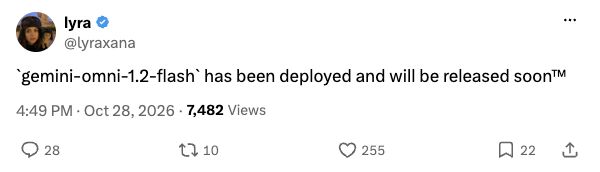
Community report: original English post, October 28, 2026.
The key development is deployment: according to this source, the model is already deployed, with the public launch expected to follow soon. For developers following Gemini Omni, 1.2 Flash is the next model ID to watch. There is no exact launch date in the message.
Google has not yet formally announced this release. Its public model page, developer guide and changelog still document gemini-omni-1.1-flash at the October 28 check. The new model's detailed specifications, official price and public API opening time are therefore still to come.
Deployment and a public launch are separate milestones. The headline here is the source's already deployed, releasing soon news; the practical next milestone is the release of model documentation and API access.
Gemini Omni 1.2 vs 1.1: what to watch at launch
The most interesting question for the coming release is how 1.2 improves actual video workflows. Three areas are especially easy to inspect in a demonstration: whether local edits preserve the rest of a scene, whether motion remains continuous, and whether an extended clip joins cleanly to its input. These are the evaluation priorities for this preview, rather than announced 1.2 specifications.
Google's released 1.1 Flash provides a useful starting point:
- Video generation and editing with native audio.
- Conversational edits that change a requested element while preserving the rest of a shot.
- Video extension and first/last-frame interpolation.
- A 1,048,576-token context and 3–10-second generated clips in the model specification.
- 360p, 720p, 1080p and 4K delivery options; 1080p and 4K use upscaling.
The launch will show which of these workflows 1.2 improves and whether Google adds new controls, longer output or different pricing. Those details have not been announced yet. The examples below make the existing Omni approach concrete and give you useful prompts to try when the new version opens.
For the earlier Omni 1.5 discussion, see our Gemini Omni 1.5 preview. This article follows the 1.2 Flash deployment news and its exact model ID.
Official Gemini Omni examples: what the workflow looks like
Google's Omni launch announcement demonstrates iterative visual transformation, including the instruction “Make the sculpture out of bubbles.” The current developer guide uses “A marble rolling fast on a chain reaction style track, continuous smooth shot.” for text-to-video.
The first example makes editing intent immediately visible: the sculpture's material changes while the surrounding scene provides a reference for what should stay consistent. The second stresses motion and continuity through a cause-and-effect sequence. These official Omni-family / 1.1 examples explain the workflow that the next release builds on; 1.2-specific demos are still to come.
When 1.2 opens, compare it with 1.1 using the same input assets and prompts. These three original prompts focus on visible differences in everyday video work:
| Test | Copyable prompt | What to inspect |
|---|---|---|
| Local material edit | Keep the camera, lighting, pedestal and sculpture silhouette unchanged. Change only the bronze sculpture into translucent soap bubbles. Preserve the surrounding room. | Whether the edit changes the intended material without replacing the object, moving the camera or rebuilding the room. |
| Physical continuity | One continuous close tracking shot of a red marble rolling down a wooden track, hitting a blue domino, and dropping into a glass bowl. No cuts. Keep all objects visible at each contact. | Contact timing, object permanence, plausible transitions and whether a cut hides a failure. |
| Video extension | Continue from the last frame. The same person in the yellow coat takes two more steps, turns toward the window and stops. Preserve the face, coat, lighting, camera height and movement direction. | The join between clips, identity, clothing, lighting and movement direction. |
The edit and extension prompts require the appropriate reference inputs and endpoint support. These are suggested evaluation tasks, not generated results. Repeat each test several times and record cost, failures and latency alongside visual quality; one selected clip cannot establish a model-wide upgrade.
Gemini Omni API pricing: what can you buy today?
Google has not announced 1.2 pricing yet. Google's published 1.1 pricing is $1.50 per million input tokens, $9 per million text-output tokens including thinking, and $17.50 per million video-output tokens.
At Google's stated 5,792 tokens per second of 720p output, video output alone costs:
5,792 × $17.50 / 1,000,000 = $0.10136 per second
A six-second output therefore corresponds to $0.60816 in video-output tokens, before input and any other output charges. This conversion is not a fixed all-inclusive Google request price, and none of these rates is a 1.2 quote.
The APIMaster 1.1 card currently has two active routes. Their base rates are approximately $0.055001/s for a 720p six-second profile and $0.096801/s for a 720p profile with automatic duration. At the lower six-second rate, six output seconds are approximately $0.330006, about 45.7% below the Google video-output reference. This compares billing rates, not identical feature coverage or proven output quality.
Other durations, higher resolutions and reference-video tasks have their own route prices. Check the selected profile before submitting. Recheck the 1.2 card for availability rather than substituting 1.2 into a working 1.1 request.
How to call the available Omni 1.1 API
APIMaster's video API uses POST https://apimaster.ai/v1/videos/generations with the available model ID gemini-omni-1.1-flash. It is not a /chat/completions request.
The following example follows the APIMaster Omni API documentation. The explicit task selects the documented text-to-video route; duration is omitted because that route determines it automatically. This is an integration example, not a paid generation test performed for this article, and it does not select the lowest-priced six-second profile.
curl "https://apimaster.ai/v1/videos/generations" \
  -H "Authorization: Bearer $APIMASTER_API_KEY" \
  -H "Content-Type: application/json" \
  -d '{
    "model": "gemini-omni-1.1-flash",
    "prompt": "A paper boat floats on a sunlit lake, gentle camera movement.",
    "resolution": "720p",
    "aspect_ratio": "16:9",
    "metadata": {"task": "text_to_video"}
  }'
Follow the returned task information and the documentation's status-query flow before downloading the result. An accepted task is not a completed video. Google SDK interactions.create examples use a different request contract; do not copy that payload unchanged into APIMaster's video endpoint.
The older gemini-omni-flash-preview is marked Shut down in Google's current catalog. Use the stable 1.1 ID for a new integration, and wait for a documented model ID, supported request format and an active route before migrating to 1.2.
FAQ
Is Gemini Omni 1.2 Flash already released?
According to community reports, gemini-omni-1.2-flash is already deployed and will be released soon. Google has not yet formally announced the public release at the October 28 check.
Can I use gemini-omni-1.2-flash on APIMaster?
There were 0 public active routes at the October 28 check. The available gemini-omni-1.1-flash had 2 routes. Check the live model cards for changes.
When will Gemini Omni 1.2 Flash launch?
Community reports say it will be released soon, without giving an exact date. The model is already deployed according to that source; official launch details are still to come.
What is the Gemini Omni API price?
1.2 pricing is still to be announced. For 1.1, Google lists $17.50 per million video-output tokens, equivalent to $0.10136/s at 720p, plus other token charges. APIMaster's current 1.1 base-route prices start at approximately $0.055001/s, depending on profile.
Is Omni 1.2 better than Omni 1.1 or Veo?
The launch demonstrations and hands-on results will show where it improves. Local edits, motion continuity and extension joins are useful first comparisons; the prompts above are ready to use when the route opens.
Sources and next step
Deployment news: lyra / @lyraxana, from the screenshot of the post supplied for this preview; author profile. The source says the model is already deployed and will launch soon.
API baseline and examples checked October 28, 2026: Google model catalog, Omni model specification, developer guide, changelog, pricing, and Google launch examples.
To use the available API, register, create an API key, set the API base to https://apimaster.ai/v1, and select gemini-omni-1.1-flash. Its current 720p base rates offer up to approximately 45.7% off Google's video-output reference; verify the live model card and chosen profile before paying. For the upcoming gemini-omni-1.2-flash, check the model card as the release approaches.