DeepSeek V4.1 Flash Preview: Speed, API Pricing and Access
DeepSeek V4.1 Flash enters testing: reported 300-507 tokens/s, V4 Flash pricing and a temporary model ID. APIMaster explains what developers need to know.
Published 2026-09-08
DeepSeek V4.1 Flash entered limited testing on September 8, 2026, according to Zhidx's report. Its temporary model ID is deepseek-v4.1-flash-expires-on-0910. The report says existing DeepSeek developers can keep their base URL, use the new model ID, and send up to 20 concurrent requests per account. Current billing matches V4 Flash. Community examples reportedly reached 300-507 output tokens/s, but these are individual observations, not an APIMaster benchmark or a guaranteed service speed.
At APIMaster, we see this release as a useful opportunity to evaluate faster model responses, multimodal workflows and API cost together. As of our September 8 public catalog check, APIMaster lists V4 Flash, V4 Pro and V4 Flash Vision Exp; the V4.1 Flash preview ID was not listed. You can create an APIMaster account to start with available DeepSeek models and compare current options in our model marketplace.
What is new in DeepSeek V4.1 Flash?
The September 8 report describes an intermediate version of V4.1 Flash using a new model architecture, with native multimodal support, stronger capabilities, faster responses and lower costs. It is an early testing release, so those claims should be read in that context.
For developers, the interesting combination is more capability at the same published API price. Lower internal model costs do not automatically mean a lower customer bill: the current preview is billed at V4 Flash rates.
The report does not specify the context window, maximum output length, supported image formats, audio or video interfaces, or detailed evaluation scores. Native multimodality alone does not establish support for every media type. We would check the actual interface and test representative inputs before designing an application around those capabilities.
How fast is it? Understanding the 507 tokens/s report
Zhidx cites developers posting their experiences on X. One reported a peak output speed of 507 tokens/s. Another obtained 328 tokens/s while generating an HTML page containing an SVG animation of a pelican riding a bicycle; a separate developer reported an average above 300 tokens/s on a similar task.
That is promising for code generation, long responses and interactive assistants. It is not yet a controlled comparison: the article does not provide a shared measurement method, full request settings or a repeatable distribution of results.
At APIMaster, we recommend looking at three measurements together:
| Measurement | What it tells you |
|---|---|
| Time to first token | How long the user waits before the response starts |
| Output tokens per second | How quickly the answer arrives after generation begins |
| Total completion time and correctness | Whether the entire task finishes quickly and produces a usable result |
Illustration, not a benchmark: a 1,000-token answer at a sustained 300 tokens/s takes about 3.3 seconds of output generation. At 507 tokens/s it takes about 2.0 seconds. Neither calculation includes queueing, initial processing, reasoning time or network delay. A faster stream is valuable, but it does not by itself prove a faster or more accurate complete workflow.
DeepSeek V4.1 Flash API pricing
The report says the preview uses the same prices as DeepSeek V4 Flash. All amounts below are Chinese yuan (CNY/RMB) per one million tokens, not US dollars and not APIMaster route prices.
| Token type | Off-peak price (CNY / 1M tokens) | Peak price (CNY / 1M tokens) |
|---|---|---|
| Cache-hit input | 0.05 | 0.10 |
| Cache-miss input | 1.50 | 3.00 |
| Output | 4.50 | 9.00 |
Cost example: 1 million cache-miss input tokens plus 1 million output tokens would cost CNY 6 off peak or CNY 12 at peak rates, using the reported prices. The example excludes other usage and assumes all input is a cache miss.
The supplied report does not define the peak-hour schedule or its timezone. Check DeepSeek's current billing documentation before scheduling workloads. For APIMaster usage, consult the live model and route price shown in the marketplace; the upstream table above is not a quote for our service.
How to access the preview, and what does 0910 mean?
For eligible developers using DeepSeek's own API, the reported change is straightforward:
model = deepseek-v4.1-flash-expires-on-0910
base_url = keep your existing DeepSeek base URL
account concurrency limit = 20
This instruction applies to the upstream DeepSeek preview. It does not establish availability through every third-party gateway, and the 20-request limit is not a published APIMaster account limit.
The model name suggests expiry on September 10, 2026. Zhidx infers the shutdown date from that name; the supplied text does not state an exact cutoff time or timezone. Treat the identifier as temporary and confirm the current upstream notice before relying on it.
We recommend keeping the model name configurable, evaluating a small set of real tasks, and retaining a tested alternative. After the preview period, use the currently supported identifier instead of assuming the expires-on-0910 model will remain available or automatically map to a successor.
Where this fits in DeepSeek's recent releases
The report places V4.1 Flash within a rapid series of model and developer-tool updates:
| Date in 2026 | Update reported by Zhidx |
|---|---|
| July 31 | V4 Flash production-version API entered public testing |
| August 13 | V4 Pro production-version API released; DeepSeek Harness developer preview v0.1 entered public testing and was open-sourced |
| August 19 | DeepSeek Harness updated to v0.1.0-rc.8 |
| August 21 | V4 Flash Vision Exp launched on the API platform |
| August 31 | V4 Flash Vision Exp was open-sourced |
| September 8 | The intermediate V4.1 Flash version entered limited testing |
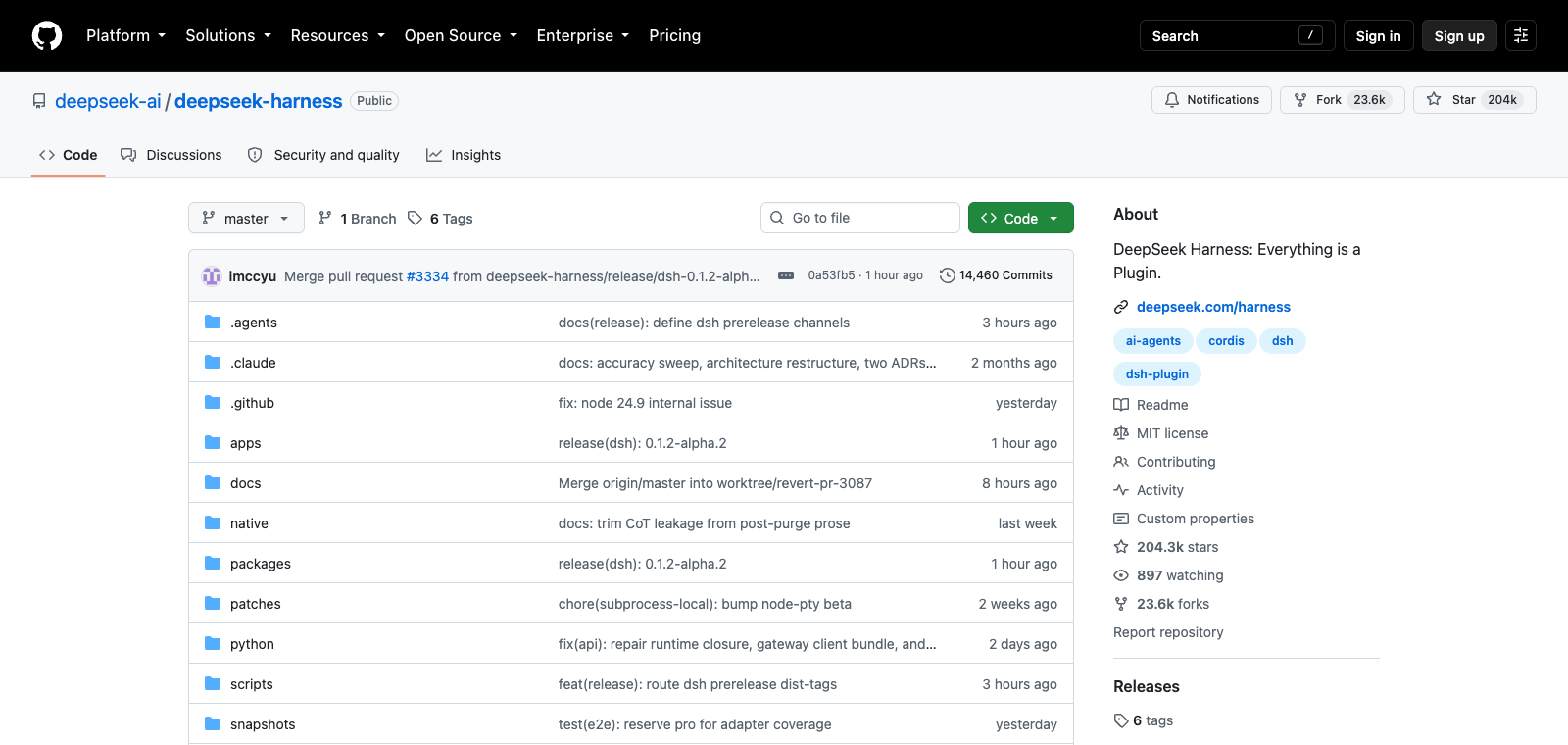
DeepSeek Harness GitHub repository. This is not a V4.1 Flash speed test.
From our perspective, the practical takeaway is that developers now have several different things to evaluate: Flash for text workloads, Pro as another model option, Vision Exp for image-related tasks, and the new temporary preview for early experimentation. The release timeline suggests continuing development; it does not confirm a date for a final V4.1 release.
Start using DeepSeek with APIMaster
Following new model releases should lead to something you can build. APIMaster brings DeepSeek and other model families into one console and an OpenAI-compatible API, so you can compare supported models without maintaining a separate integration for each provider.
Our public catalog check on September 8, 2026 returned deepseek-v4-flash, deepseek-v4-pro and deepseek-v4-flash-vision-exp. The temporary deepseek-v4.1-flash-expires-on-0910 identifier was absent from that result. Check the live marketplace for current availability and pricing before choosing a model.
To get started:
- Register for APIMaster.
- Choose an available model and review its current price and supported interface.
- Open the console, add credit as needed and create your API key.
- Configure your application with the APIMaster base URL and selected model ID.
- Send a small request, inspect the result and usage, then scale to your workload.
Here is a text example using the currently listed V4 Flash, rather than the temporary preview:
import os
from openai import OpenAI

client = OpenAI(
    api_key=os.environ["APIMASTER_API_KEY"],
    base_url="https://apimaster.ai/v1",
)

response = client.chat.completions.create(
    model="deepseek-v4-flash",
    messages=[
        {"role": "user", "content": "Write a Python function that validates an email address."}
    ],
)

print(response.choices[0].message.content)
For setup details, read our DeepSeek API guide and API key guide. You can also use our DeepSeek API tester to check connectivity and responses. A successful connectivity test does not by itself verify model identity or establish a performance benchmark.
FAQ
What is the DeepSeek V4.1 Flash preview model ID?
The reported identifier is deepseek-v4.1-flash-expires-on-0910. It belongs to a temporary intermediate testing release announced in the September 8, 2026 report.
Is V4.1 Flash cheaper than V4 Flash?
The current preview API price is the same as V4 Flash according to the report. Off-peak cache-miss input costs CNY 1.50 per million tokens and output costs CNY 4.50; peak prices are CNY 3.00 and CNY 9.00 respectively. These are reported upstream prices, not APIMaster quotes.
Does DeepSeek V4.1 Flash guarantee 507 tokens/s?
No. The 507 tokens/s figure is an individual community result cited by Zhidx. APIMaster has not presented an independent V4.1 Flash benchmark in this article, and actual performance depends on request settings, workload and service conditions.
Is the V4.1 Flash preview available on APIMaster?
It was not listed in our September 8, 2026 public catalog check. V4 Flash, V4 Pro and V4 Flash Vision Exp were listed. Consult the live marketplace for subsequent availability changes.
When does the temporary model expire?
The name suggests September 10, 2026. The supplied report infers that date from the model ID and does not provide an exact time or timezone. Confirm DeepSeek's current notice and keep an alternative model ready.
Turn model news into your next project
V4.1 Flash's preview is worth following for its reported speed and multimodal direction. For work you want to start today, choose a currently available model, measure the results on your own tasks, and build from there.
Create your APIMaster account to explore DeepSeek and other supported models, compare current API prices and make your first request through one familiar interface.
Compare discounted routes and use pay-as-you-go billing; savings depend on the model and route you select.