Private conversations with local models
Use local Ollama models for chat and avoid uploading data to the cloud
Best for:Privacy-conscious individual users
General Chat / Assistant
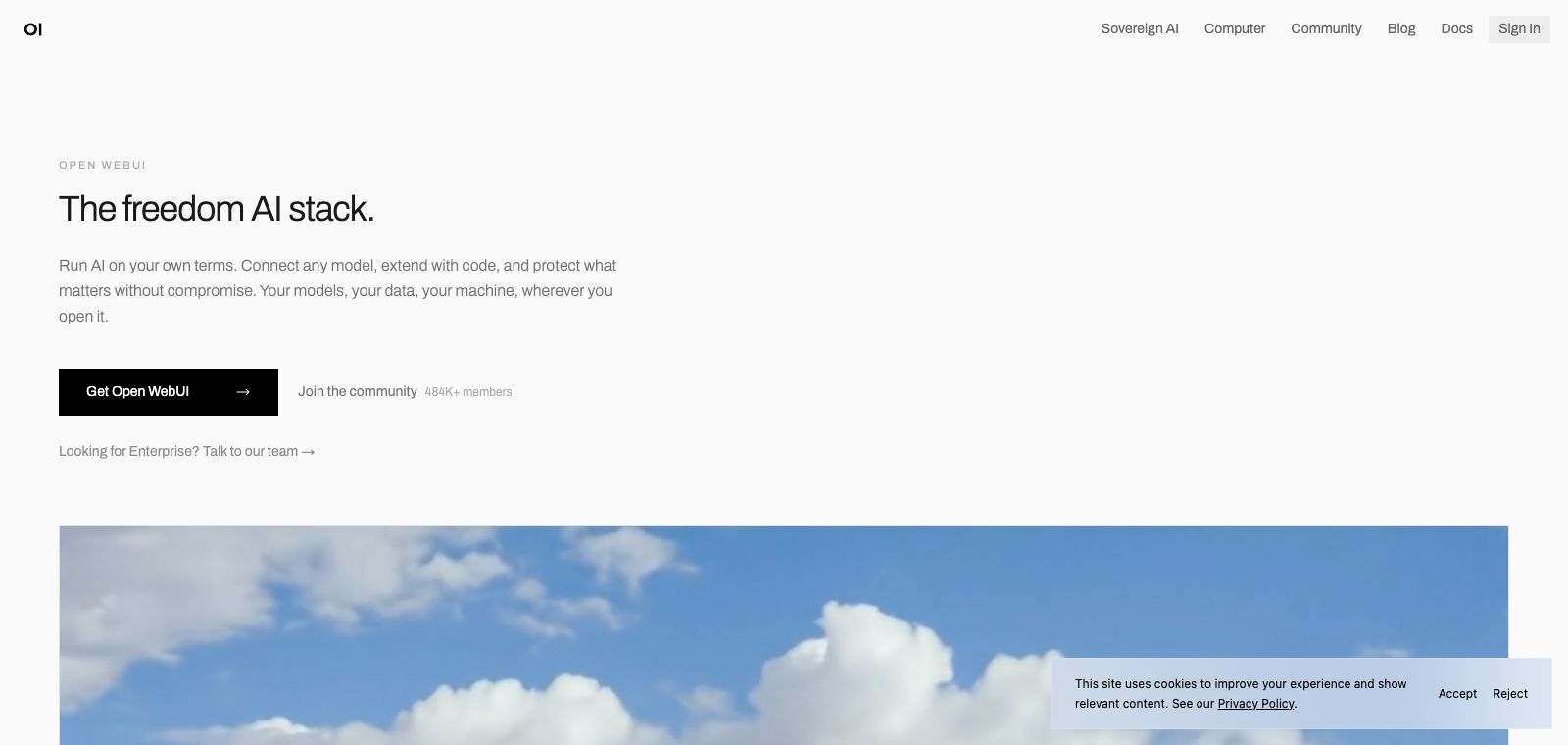
Open WebUI is an open-source self-hosted web interface primarily used to connect local LLM backends for chat interactions.
Website created
2024-02-17
OpenRouter token usage rank
#36
Sources: OpenRouter
Monthly unique visitors
471,550
Sources: SimilarWeb
Coding Plan
Coding Pro model discounts
Open WebUI is a locally deployed chat tool that users access through a browser and connect to backend services such as Ollama to run models. It supports features such as multi-model switching, conversation history management, and file uploads, making it suitable for developers to set up on personal devices or servers. Unlike cloud-based chat services, it requires users to manage model downloads and runtime environments themselves, with an emphasis on keeping data local.
One-line summary
Open WebUI is an open-source self-hosted web interface primarily used to connect local LLM backends for chat interactions.
What people use it for
Users open its interface in a browser, select a local model, and enter questions for conversation, or upload documents so the model can answer based on their content.
Best for
General assistant users and multi-scenario workflow users
How it works
Users typically first access the product from the command line, desktop, or browser, then complete work through multi-step task planning and tool calls.
Product type
Model gateway / routing tool
Pricing
Unknown
The current enhanced batch dataset does not maintain real-time pricing for this product. Refer to the official website or official documentation.
APIMaster integration
Supported
Open WebUI → Settings → Admin → Connections, or User Settings → Connections
Data confidence
Medium
Last verified: 2026-09-02
Can connect directly to a local Ollama instance or any OpenAI-compatible API endpoint
Supports uploading files and building a knowledge base for retrieval-augmented generation
Generates interactive code snippets, apps, or visual content
Supports user accounts, role assignment, and model access restrictions
Enables fast self-hosted deployment through Docker, with offline support
Use local Ollama models for chat and avoid uploading data to the cloud
Best for:Privacy-conscious individual users
Use prompts to have the model generate and run apps such as games or tools
Best for:Developers
Upload documents to build a knowledge base and ask questions to get document-based answers
Best for:Researchers or document managers
Assign accounts and model permissions to team members
Best for:Small teams or organizations
Base URL
https://apimaster.ai/v1API key environment variable
API Key(Connections 配置项)Model
Your APIMaster model IDDiscussion summary
Users commonly understand Open WebUI as a self-hosted ChatGPT-style interface mainly used to run LLMs locally or connect to backends such as Ollama for private AI conversations. Discussion focuses on how to deploy it through Docker or simple commands, connect multiple models and APIs, and implement RAG and knowledge base features for handling private documents. Users also frequently share prompt templates, build custom agents such as storyboard generation or voice chat, and emphasize the advantages of data privacy and offline use, while comparing it with paid AI service alternatives.
Users discuss one-click installation, Docker configuration, authentication settings, and how to make the interface automatically detect local models for a local chat experience similar to ChatGPT.
Users share practices for uploading documents, building private knowledge bases, and adding citation search, with a focus on document indexing and retrieval performance under privacy constraints.
Users exchange methods for building creative agents such as storyboard generation and video prompts, enabling parallel responses from multiple models, and integrating with voice tools.
Users recommend high-quality prompts from the official website or GitHub, methods for importing templates, and ways to reuse them across different models to improve output quality.
Users compare privacy, cost, and offline capabilities, discuss the limitations of local models in complex reasoning, and share practical strategies for mixed use with API keys.
We currently place it in the "General chat / assistant" category, and the page description is based on the official website and public sources such as OpenRouter.
The enhanced Open WebUI page prioritizes the core tasks and use cases that have been collected, helping you quickly judge whether it matches your current needs.
Current information has already confirmed that the product supports third-party keys or custom compatible endpoints, so you can continue validating directly according to the configuration instructions on the page.
It is also in the general chat / assistant category and can be used for side-by-side comparison of different task entry points and product formats.
It is also in the general chat / assistant category and can be used for side-by-side comparison of different task entry points and product formats.
Sources:Official websiteOfficial docsGitHub
Last verified: 2026-09-02 · Report a correction