
Generate complete social videos from a single idea
Input product or content ideas and output polished videos ready for direct publishing
Best for:Content creators
Creative / Content

Agent Opus is an AI video agent for social media. After users input prompts, links, or materials, it can generate videos ready for direct publishing.
Website created
2021-09-12
Monthly unique visitors
222,638
Sources: SimilarWeb
Coding Plan
Coding Pro model discounts
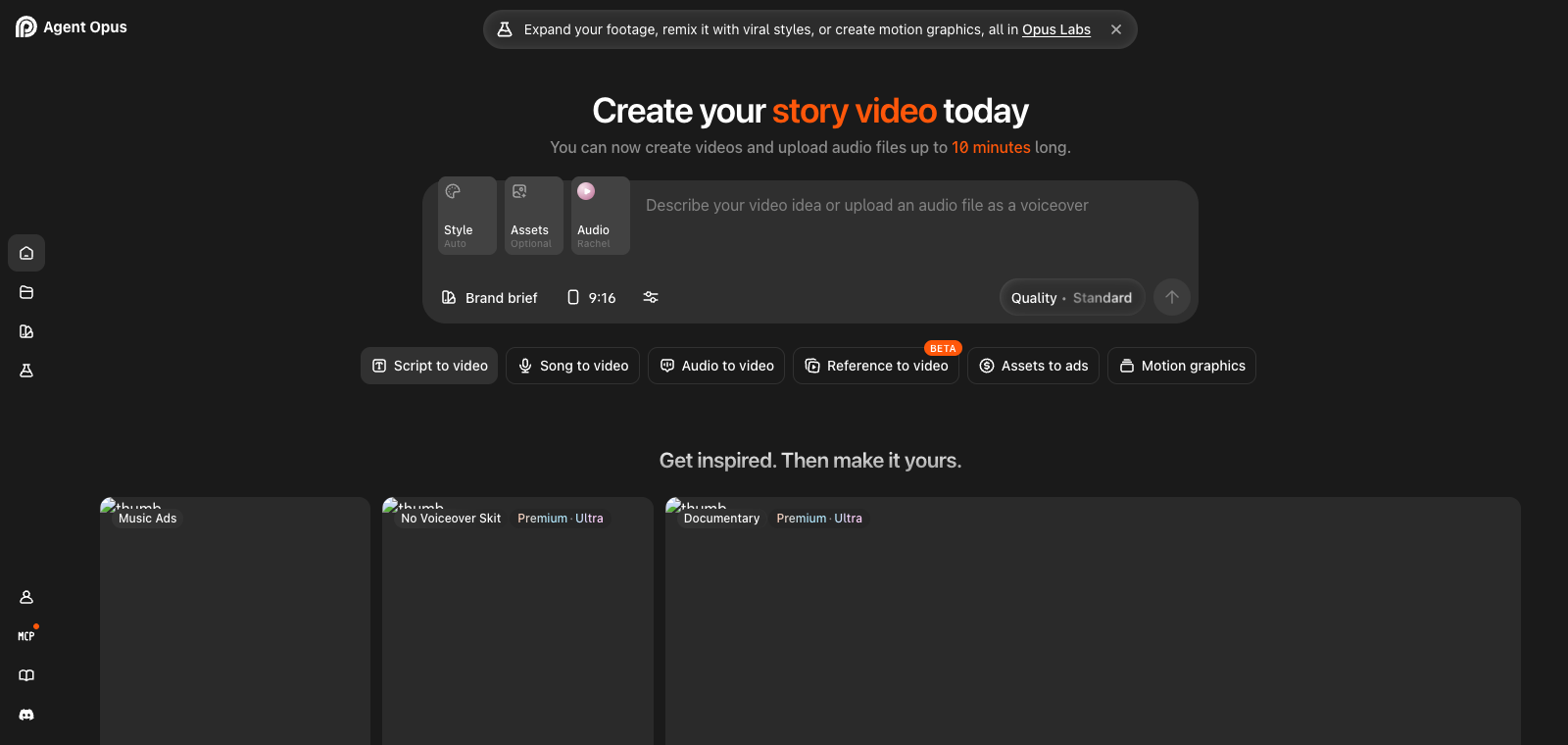
Agent Opus is positioned as an end-to-end video creation tool, completing the full process from research, scripting to editing through multiple specialized agents. Users primarily trigger creation by uploading blog posts, audio, scripts, or song links. The system automatically fetches real-time web materials and generates dynamic graphics and voiceovers matching the style. The product targets content creators and individuals or small teams who need to frequently produce social videos. Its difference from single-model video generation tools lies in using multi-agent collaboration with role division, rather than a single generation step.
One-line summary
Agent Opus is an AI video agent for social media. After users input prompts, links, or materials, it can generate videos ready for direct publishing.
What people use it for
Users drop blog posts, audio files, or songs into Agent Opus to get complete videos with real-world assets and custom dynamic graphics; users can also upload songs to directly generate music videos matching the rhythm.
Best for
Content teams, creators, and design production teams
How it works
Users typically access the product from a browser and invoke its built-in capabilities around specific tasks to complete work.
Product type
Platform Product
Pricing
Unknown
The current enhanced version batch data has not maintained real-time pricing for this product. Please refer to the official website or official documentation.
APIMaster integration
Unknown
Pending verification
Data confidence
Low
Last verified: 2026-09-02
After inputting prompts, links, or media, automatically completes the full process of research, script writing, asset organization, dynamic graphics, voiceover, virtual avatar, and editing
Completed videos can directly select new visual styles (such as Voxel Craft, Claymation, Cartoon Sitcom, etc.), retaining the original script and scenes for regeneration
Directly generates motion graphics and voiceover for faceless explainer videos from a single text prompt
Automatically fetches and integrates real-world assets into videos based on prompts
Automatically creates lifelike avatar and synchronously adds professional voiceover
Input product or content ideas and output polished videos ready for direct publishing
Best for:Content creators
Upload edited videos and quickly switch to different animation styles via the Reimagine feature
Best for:Video producers
Input text prompts to automatically generate explainer videos containing motion graphics and voiceover
Best for:Business content teams
Quickly generate multiple versions of videos based on validated formats and adjust visual elements
Best for:UGC creators
We do not yet have reliable evidence that this product supports third-party keys, proxies, custom providers, or a custom base URL, so we do not show speculative setup steps or config values.
Discussion summary
Users typically understand Agent Opus as an AI tool that generates publishable videos with one click, mainly used for creative content creation such as music videos or POV short clips. Discussions focus on how to quickly produce videos through prompts or songs, output effects when actually used for UGC or brand promotion, and practicality issues of the tool in real scenarios.
Users share specific steps to create music videos via the official website link and discuss suitable prompts and output formats.
After user testing, feedback indicates occasional text confusion or visual errors in output, discussing suitability for real brand promotion.
Users share content production processes after brand collaborations, format optimization tips, and traffic improvement methods.
Users describe results of testing viral promotion videos with the tool and discuss gaps between technical maturity and expectations.
We currently classify it under the “Creative / Content & Media” category. Page descriptions are based on the official website and public materials such as OpenRouter.
The enhanced version page of Agent Opus will prioritize displaying collected core tasks and use cases to help you quickly determine if it matches your current needs.
There is currently no reliable source confirming that the product supports third-party Key or custom compatible endpoints, so the page status will show as pending verification.
Belongs to the same Creative / Content & Media category and can be used for horizontal comparison of different task entry points and product forms.
Belongs to the same Creative / Content & Media category and can be used for horizontal comparison of different task entry points and product forms.
Belongs to the same Creative / Content & Media category and can be used for horizontal comparison of different task entry points and product forms.
Sources:Official website
Last verified: 2026-09-02 · Report a correction